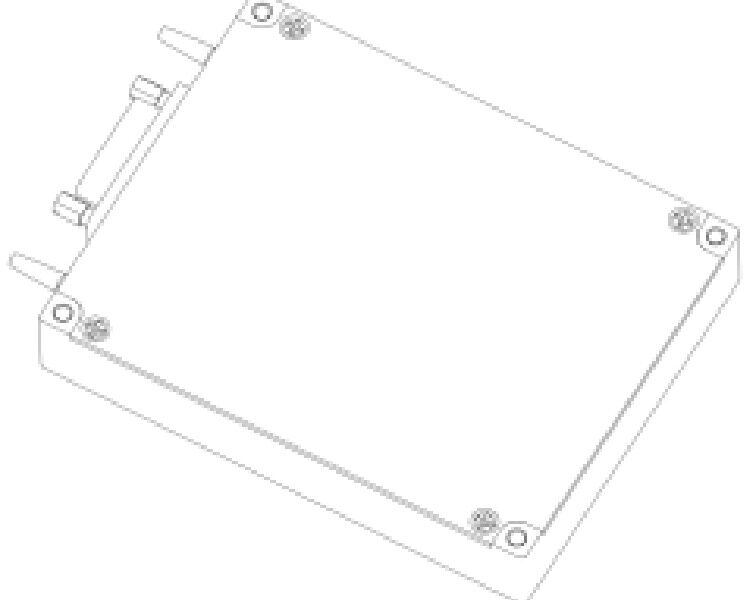
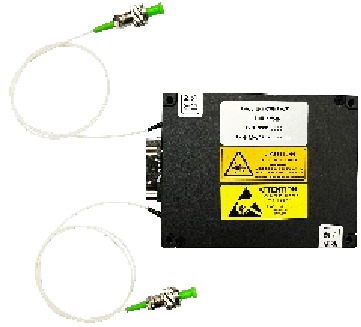
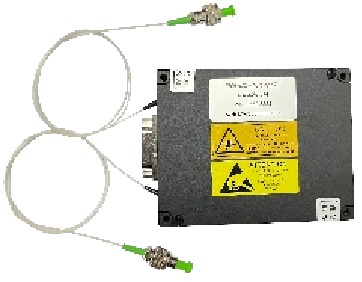
A distributed fiber sensing system is limited by its optical front end long before it is limited by its detector. The pulse amplifier sets the launch power, the source sets the linewidth that decides how far you can integrate, and the circulator decides how much of the returning light actually reaches the receiver. Those three parts are what we supply.
The 1550 nm chain in a DTS, DAS or DSS interrogator
A narrow-linewidth source seeds a pulse amplifier — usually a C-band EDFA — which is launched into the sensing fiber through a circulator; the backscattered light returns through the same circulator to the receiver. Every dB of loss in that loop is a dB of range, and every dB of isolation is noise that does not reach the detector.
| Function | What we supply | Published figures |
|---|---|---|
| Pulse amplification | C-band EDFA modules in CW, pulsed and miniaturised form | Output +20 to +40 dBm; typical gain 30 dB; noise figure ≤5 dB; input/output isolation ≥45 dB |
| Routing | PM circulators and isolators at 1550 nm | Isolation 45 dB at 23 °C, 35 dB minimum over −40 to +60 °C; return loss 70 dB; PER 20 dB |
| Filtering | PM filter isolators, WDMs, FBG and Raman FBG mirrors | PM filter isolator at 30 W: isolation ≥28 dB, return loss ≥50 dB |
| Sources | 1550 nm narrow-linewidth sources; 1064 nm single-frequency options | Linewidth and power quoted per configuration before order |
What decides whether we can help
Two answers settle it: is the probe amplified by an EDFA or by a Raman pump, and what is the required linewidth. The first decides whether you need an amplifier module or a pump-side part; the second decides whether a standard source is comparable at all. Send those two, plus pulse width and repetition rate, and the reply will be a specific part rather than a range.
Common questions
EDFA or Raman amplification for DTS?
It depends on range and budget rather than on principle: an EDFA module is simpler to integrate and needs one pump wavelength, while Raman pumping distributes gain along the fiber and needs higher pump power and a combiner rated for it. We supply the amplified module either way, and will not claim one is universally better.
What noise figure do you publish?
≤5 dB typical on our C-band EDFA modules, with input and output isolation ≥45 dB and return loss ≥45 dB. Because the figure moves with gain setting and input power, the factory confirms it for the exact configuration before quotation.
Do you have polarization-maintaining versions for coherent DAS?
Yes — PM circulators, PM isolators and PM filter isolators are all in the published range, and the PM circulator holds 35 dB isolation across −40 to +60 °C rather than only at room temperature.