Two-micron fibre amplifiers have moved out of the lab. Wind lidar, gas sensing, medical and defence programmes all buy them now. But most of the build problems I hear about are not in the thulium fibre — they are on the pump side, where a combiner specified for 976 nm is quietly asked to work at 793 nm.
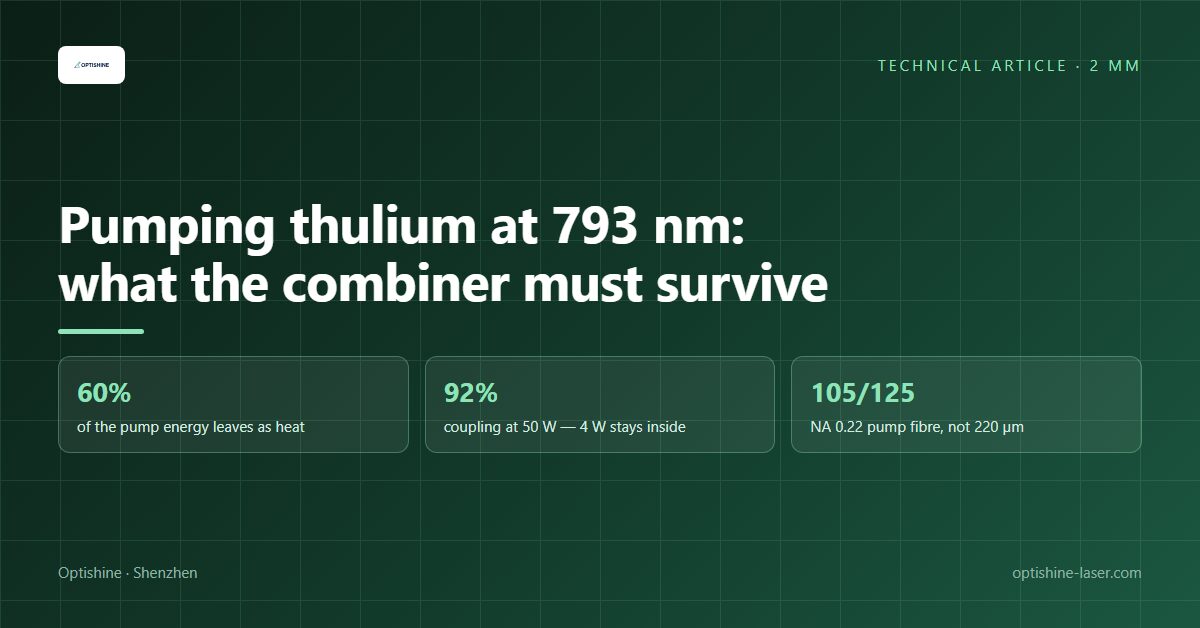
- 60% of a 793 nm photon leaves as heat by the time it becomes a 2000 nm photon.
- 92% pump efficiency at 50 W leaves 4 W inside the combiner package — that is a thermal design, not a datasheet line.
- 105/125 NA 0.22 pump delivery is a smaller etendue than 976 nm builds, so the combiner geometry changes with it.
Why 793 nm, and what it costs
Thulium has its pump absorption band around 790–795 nm, feeding the 3H4 level. The useful part is the cross-relaxation process: one 793 nm photon can end up exciting close to two ions, which is why 2 µm amplifiers can show slope efficiencies above the Stokes limit.
The price is the quantum defect. A 793 nm photon carries 1.56 eV; a 2000 nm photon carries 0.62 eV. Roughly 60% of the pump energy leaves as heat, wherever it is absorbed — in the gain fibre, and in anything the pump light touches on the way there.
That single number drives the whole pump-side design. You are not fighting a 20% thermal load as you would at 976 nm; you are fighting 60%.
The brightness budget is smaller than you think
Standard 793 nm pump delivery uses 105/125 fibre with NA 0.22. That is a smaller etendue than the 220 µm pump fibres common at 976 nm, so the combiner geometry differs: fewer ports, and a taper that lands in a 200/220 cladding rather than a 400 µm one.
| Parameter | Value |
|---|---|
| Pump wavelength | 793 nm |
| Min. pump efficiency | 92% |
| Max. pump power handling | 50 W |
| Pump input fibre | MM-105/125, NA 0.22 |
| Output fibre | MM-200/220-22A |
| Operating temperature | 0 to +40 °C |
Fifty watts is the honest ceiling for this package. If a build needs 200 W at 793 nm, that is a different combiner with a different thermal path — and saying so early is cheaper than discovering it during qualification.
Where the 50 W goes
At 92% coupling, 50 W of pump leaves 46 W in the cladding and 4 W inside the package as heat. That 4 W is what the housing has to move, and it is why a 793 nm combiner cannot simply reuse the mechanical design of a 976 nm part that handles four times the power.
The other 60% — the quantum defect — is generated in the gain fibre, not the combiner. Builders who budget cooling only for the combiner are usually surprised by the fibre coil.
Cladding light stripping is not optional at 2 µm
A thulium amplifier typically leaves 5–15% of the pump unconverted. At 50 W that is 2.5–7.5 W of cladding light that must leave the fibre before the output end, or it lands on the connector, the isolator, or the work piece.
Two practical points:
- Strip before the output, not after the isolator. Cladding light that reaches a 2 µm isolator is absorbed in the element and shifts its thermal budget.
- Ask for the stripped power, not the efficiency. A stripper quoted at “>99%” tells you nothing; one quoted at 30 W stripped power tells you whether it fits the build.
For a 2 µm build, ask the combiner supplier for pump fibre type, output fibre type, pump efficiency at rated power, and the package thermal assumption. If the last one is missing, the number was measured on a bench, not in a box.
What the pump-side RFQ should contain
- Pump wavelength and total pump power, plus how many emitters.
- Pump fibre type — core/cladding and NA (105/125 NA 0.22, or something else).
- Output fibre and cladding diameter you need to match (200/220, 250/250, …).
- Whether you need a signal feed-through, and at what wavelength and power.
- Cooling: free convection, cold plate, or water.
With those five, a supplier can either quote or tell you the part does not exist — which is worth more than a catalogue page.
One honest limit
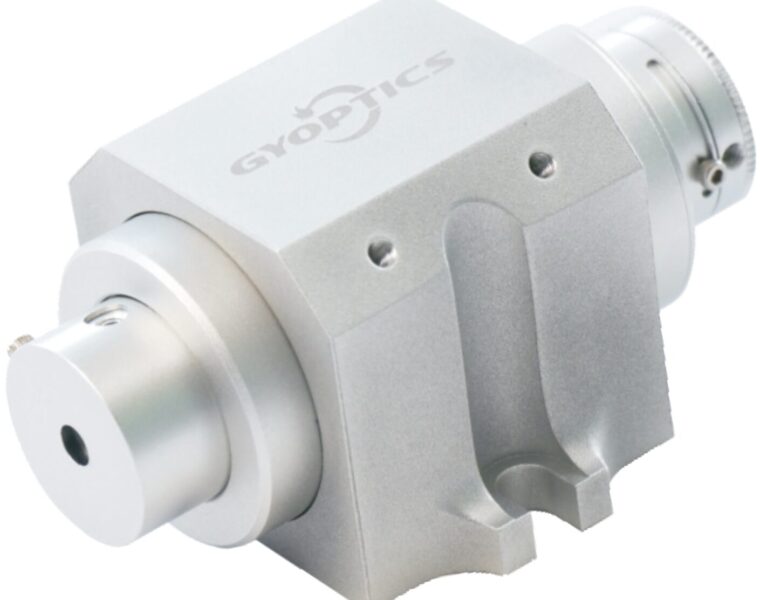
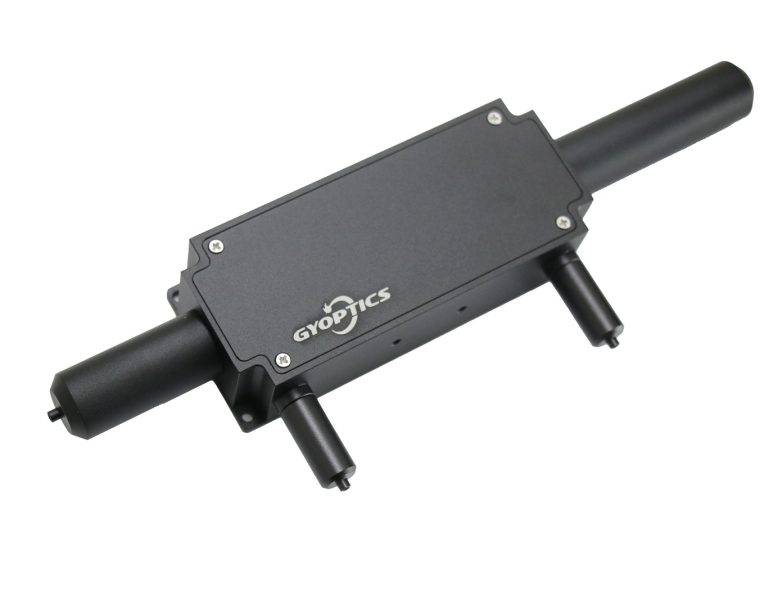
Our 793 nm range is a 7×1, 50 W combiner built with our partner factory in Zhuhai, paired with an MFA + CPS module when the build needs cladding-light stripping. It suits low and mid-power thulium amplifiers, seeding stages and sensing systems. It is not the right part for a 100 W-plus thulium amplifier, and I would rather point that out here than after a purchase order.
If you are sizing a 2 µm pump path now, send the five lines above and I will tell you whether our part fits — and if it does not, what the alternatives look like.
Warren Wu is Sales Director at Optishine (Shenzhen), a supply-chain company for the laser industry backed by the Guangdong Laser Industry Association. The components are produced by partner factories in Zhuhai; Optishine handles specification matching, export documents and after-sales.